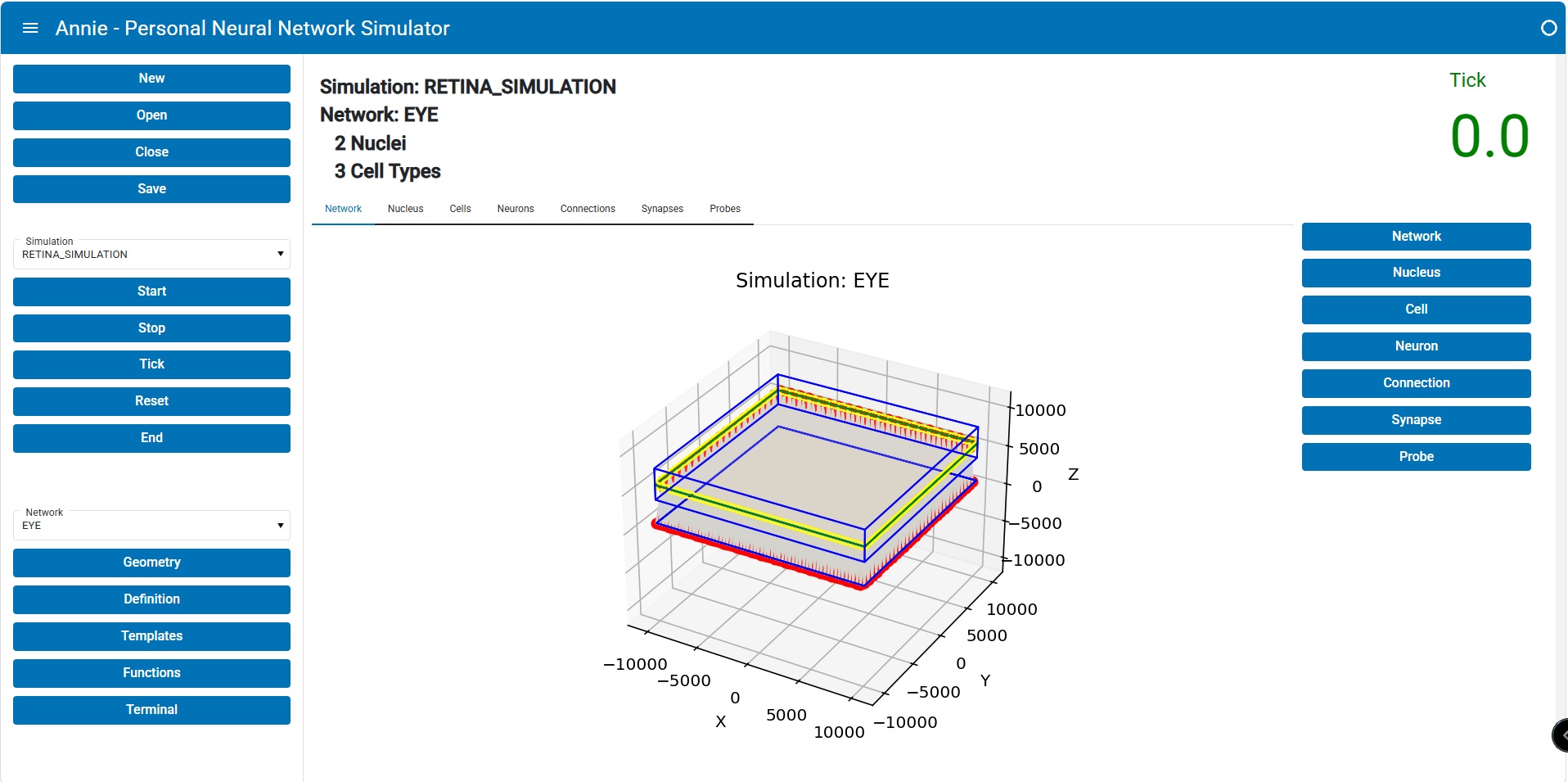
Annie is a neural network simulation engine, and so much more. She can interface with other simulators, build complex networks in minutes with simple defintions, render your network geometry and visualize your simulations in real time. Annie is so good at building networks, you'll want to use her capabilities and export the results. Annie understands anatomy, you can ask her to build a cortical module and she'll know what it is and how to build it.
Annie brings
things to the table that the others simply don't and can't handle. Annie is
complementary and supplementary, it's an essential interface tool for every neuroscientist
and anyone interested in neural modeling, including machine learning engineers. Annie comes in several flavors, there is a blazingly fast standalone application for personal use, a client-server implementation that supports multiple simultaneous users, an assortment of import-export capabilites including Brian2, Nest, Nengo, NeuroML, TensorFlow, PyTorch, Pandas dataframes, CSV files, Wavefront OBJ and other formats compatible with mesh tools like Maya and Blender, and of course real-time activity probes that can be visualized on the PC screen.
What is Annie? That question can best be answered by illustration. Let's do it
in stages, beginning with the simplest and easiest. The first thing you'll want
to know about Annie is the workflow. What is Annie good for? What does it do,
that you desperately need, and the other guys can't do?
The one-word answer is: geometry. You may have noticed, that the existing neural
network simulators are pretty miserable in the area of geometry. It's difficult
and painful to create connection geometry in Brian2 or TensorFlow. And yet, the
connection geometry is at the basis of every functional neural network model.
As any machine learning engineer will tell you, there's only so much you can
do with all-to-all connections. And human brains don't sweep convolutional filters
across images. Annie addresses a middle ground between TensorFlow and Brian2, and
it adds two things into the mix that are hard to find anywhere else: geometry,
and dynamics. Here's an example: in the simulator, I want to sweep some visual
gratings across a retina and look at the receptive fields of the ganglion cells.
To do that, I need more than just a neural network. For one thing, I need some
stimuli, some way of creating gratings and applying them to the neurons. And,
I'll probably want to run an organized set of experiments, rather than haphazardly
showing gratings to my network to see what happens. I'll probably want to do batches
of simulations at different grating orientations, at different levels, and perhaps
with some rotations or translations. And I'd like to do this within my lifetime,
it has to take no more than half a day to set all this up, because my time needs
to be spent on neuroscience, not on mucking with computers.
Enter Annie. Annie is much friendlier than experimenting on animals - but when
it comes to simulations, we'd like to organize the scientific effort in much the same way. Typically we run many experiments under slightly different conditions,
perhaps re-using the same stimulus set, or maybe with slight variations in the input.
In a neural network we might add a connection here or there, to see how it affects
the network behavior. In a good world we can play around interactively, and when
we discover something useful we can save the current network immediately to the
hard drive in an easily readable and editable form. (XML is a little painful, it's
hard to read and even harder to validate).
Let's find out how Annie can help.
We have to start at the beginning, because neural network modeling is a broad subject. Annie's geometrical capabilities are worth a dozen pages alone - for example how about the ability to create a simple nucleus inside Annie, export it to Blender, align it with any of the brain maps from the Allen Institute, and then import it back into Annie as a mesh. This whole process can be accomplished in 5 minutes or less!
The sales pitch is pretty easy with this product. It does all the things the other guys wish they could, and the general reaction from scientists who see Annie for the first time is "where have you been all my life"! But let's get concrete and take a look at how the philosophy behind Annie makes for a powerful workflow tool that increases productivity and reduces time to publication. Please visit the About Page to find out more. (It's at the top of your screen!)
Find Out More
|